
Annanim News
Now
Defense techReport: Australia considers buying US-made Iron Dome interceptorsCybersecurityMore than 1,000 GitLab servers still exposed to an actively exploited critical flawTools & productsWix unveils Studio Two: a site editor with an AI agent, React code and MCP supportQuantum & precision measurementSouth Korea switches on the Hangang supercomputer and will link it to a quantum computer in 2027CybersecurityCheck Point shares fall about 10% after weak third-quarter resultsDefense techElbit wins $170 million deal to build a training and simulation center for the IDF Artillery CorpsRegulation & businessElectric trucks reach 50% of heavy truck sales in ChinaCybersecurityNvidia: Brev platform breach may have exposed SSH keys to customer machinesTools & productsMusk cuts Grok Bot usage limits over "unsustainably high" costsTools & productsOpenAI is merging ChatGPT's Chat and Work tabs

Originally published:

South Korea switches on the Hangang supercomputer and will link it to a quantum computer in 2027

South Korea's sixth national supercomputer, with 8,496 GPUs, is now fully operational with 24 times the theoretical performance of its predecessor. The government plans to connect it to a quantum computer in the first half of 2027.

South Korea switches on the Hangang supercomputer and will link it to a quantum computer in 2027
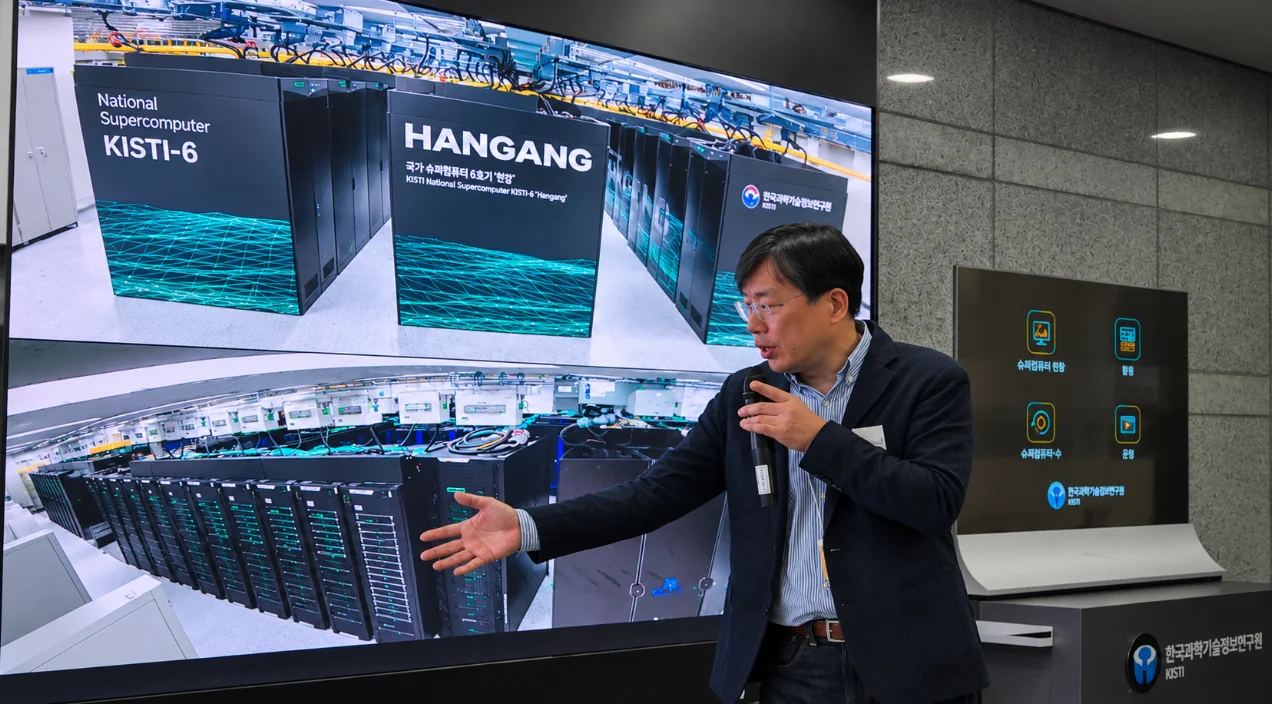
Image: The Quantum Insider (opens the source site in a new tab)

South Korea has brought Hangang, its sixth national supercomputer, into full operation at a ceremony at KISTI headquarters in Daejeon on November 2, The Quantum Insider reports, citing Seoul Economic Daily. The system has 8,496 GPUs, among them Nvidia's GH200, and 9,936 CPUs, with 24 times the theoretical performance of Nurion, its 2018 predecessor. The government expects it to rank among the world's ten most powerful supercomputers.

The Ministry of Science and ICT and KISTI plan to connect Hangang to a quantum computer in the first half of 2027, creating a hybrid system of high-performance computing and quantum processing meant to speed up calculation and optimization.

Unlike its predecessor, Hangang uses direct liquid cooling, with water flowing over the chips themselves. According to Hong Tae-young, head of KISTI's Supercomputing Infrastructure Center, power usage effectiveness (PUE) improved to about 1.15, from 1.35 on the previous system.

Sources

Topics

Install the app

In Safari: tap the Share button, then “Add to Home Screen”.