

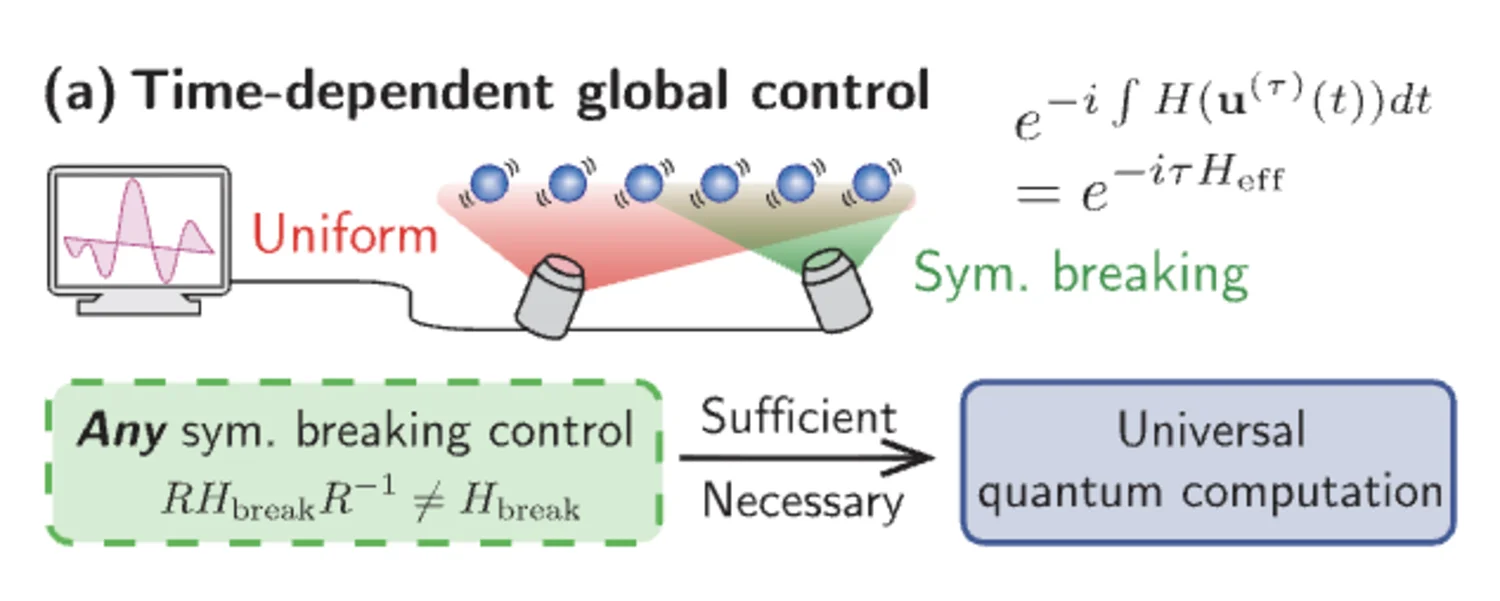
Many quantum simulators are controlled by a few laser fields that act on all atoms at once. A study by Hong-Ye Hu and colleagues, forthcoming in Nature Physics, addresses whether such a system can perform any quantum operation. According to The Quantum Insider, for a one-dimensional qubit chain with uniform nearest-neighbor interactions, the only remaining obstacle is mirror symmetry: atoms on opposite sides of the chain are indistinguishable. A controllable field or interaction that breaks that symmetry makes universal quantum control possible.
To turn the theory into a practical method, the team developed an optimal-control technique that searches for pulse sequences while accounting for laser limits and atomic motion. In a Rydberg-atom array, the pulses produced an effective ZXZ interaction among three neighboring atoms, beyond the hardware's native pair interactions. In a chain of eight atoms, the end atoms showed signals consistent with topological edge modes. The paper is currently available as a preprint.