

Monday, 16 November 2026
22 stories

Fandango: payment card details stolen from the site's checkout pages
Fandango, the US movie ticketing site, is notifying customers that malicious code injected into its checkout page intercepted payment card details between October 8 and 11.

Google's Project Zero cuts its vulnerability disclosure window to 30 days by 2028
Google's Project Zero will move to a 60-day disclosure window in February 2027 and a 30-day window in January 2028, and is ending the 30-day post-patch grace period now.
ARTEX keeps spreading: Barracuda breached, and Amazon captured records of the attack agents
Security company Barracuda disclosed it was breached in early November using ARTEX, an AI-agent penetration-testing framework. Separately, Amazon's threat intelligence team described campaigns in which ARTEX agents hunted AI provider API keys in exposed apps.

Altera, OQC and Nvidia link a quantum processor to GPU computing through an FPGA-based controller
Altera developed, with Oxford Quantum Circuits and Nvidia, a reference design for an FPGA-based quantum computer controller that runs an OQC quantum processor and connects to Nvidia GPUs over NVQLink. The demo will be shown at SC26 in Chicago.

NoisyTCP: an 11-year-old Linux kernel flaw lets attackers crash servers remotely
A Linux kernel vulnerability, CVE-2026-99288, affects almost all distributions and lets an unauthenticated attacker remotely crash servers running Nginx, Apache or SSH with default settings. A fix is already available.

Israel's Corma raises $125 million at a $1 billion valuation
Cybersecurity company Corma, which develops language models and AI agents to defend organizations, completed a $125 million Series A led by NEA at a $1 billion valuation. It comes three months after the company emerged from stealth.

Uber breach: details and driver's licenses of about 150,000 drivers stolen via Fireworks AI
Uber is notifying about 150,000 drivers that their personal information was stolen at a third-party service provider. The company confirmed the provider is Fireworks AI, the cloud platform for running AI models that was breached in October.

Alibaba launches Qwen4-Max: 2.4 trillion parameters, a million tokens and lower prices
Alibaba made its flagship Qwen4-Max model generally available through QwenCloud, after a limited preview that began on November 11. According to the company, average task cost fell by about 58% compared with the previous generation.

Vulcan launch fails: 40 Amazon Leo satellites lost
ULA's Vulcan rocket, carrying 40 internet satellites for Amazon Leo, Amazon's rival to Starlink, suffered an anomaly about ten minutes after launch on Sunday and failed to deliver them to orbit. The cause is not yet known.

Anthropic: Claude Mythos ported a model to AMD chips in three days, instead of up to a year
Anthropic told investors ahead of its IPO that Claude Mythos Preview did almost on its own the software work needed to run one of its models on AMD MI355X GPUs, in about three days. It says such work used to take six to 12 months.

Google warns: fully autonomous AI-agent cyberattacks within six months
Google Threat Intelligence Group (GTIG) reported that attackers already use AI agents to find and exploit vulnerabilities with no human involved. It estimates that simple attacks needing little to no human interaction will appear within three months, and sophisticated, fully autonomous ones within six.

US tightens AI chip export rules: licenses now cover remote access from restricted countries
The US Commerce Department is issuing an interim rule requiring licenses to export AI chips and servers to data centers anywhere in the world if they may provide compute to companies from China or other restricted countries. The rule also formally rescinds the Biden-era AI Diffusion Rule.
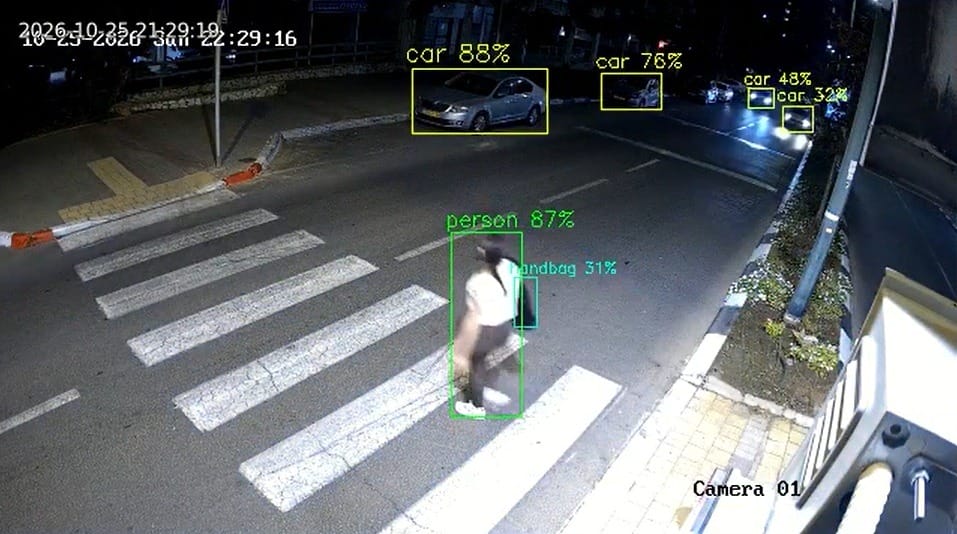
Herzliya begins a smart crosswalk pilot using computer vision
The Herzliya municipality will install a system by ConnVAS at two crosswalks on Sokolov Street that detects pedestrians and vehicles approaching the same crossing and warns both.

Indian chip startup Bharat Semi raises $24 million for AI image sensors
New Delhi-based Bharat Semi raised a $24 million seed round to develop image sensors that combine capture, processing and AI on a single chip. The pre-revenue company is targeting first commercial production in 2027.
Microsoft 365 outage led to chlorine gas poisoning of 15 hotel guests in Germany
A safety system in a German hotel's sauna area relied on email to warn of high chlorine levels. During Microsoft's global outage the alerts were not sent, and 15 guests were affected.

Apple launches a research app to study how people use AI for health questions
Apple and OpenEvidence launched a US research app that answers everyday medical questions with responses grounded in clinical literature. The goal is up to 200,000 participants for more than 12 months.

DARPA tests a pack of four autonomous ground vehicles in a simulated exercise
In mid-October at Fort Knox, Kentucky, four unmanned ground vehicles (UGVs) worked as an autonomous team that surveyed terrain and located simulated targets. Every decision to fire stayed with a human operator.

NIS 1.5 billion industrial complex for chips and deep tech planned in Ashkelon
Investment group Awz and Nadav B. Logistics Group signed an agreement to build compound semiconductor manufacturing facilities in Ashkelon's planned National Deep-Tech Park. The land and construction investment is estimated at about NIS 1.5 billion ($470 million).

China Watch: COMAC's electric airliner makes its first crewed flight
Three stories from China and the region: COMAC's CE-25A electric airliner completed its first crewed flight, Singapore's Megaspeed rejects claims about its supply chain and distances itself from Alice Huang, and China's first fully AI-generated feature film flops at the box office.

Congress moves to tighten AI chip export rules after the Nvidia affair
Following the affair that led to Jensen Huang's resignation from Nvidia, members of Congress from both parties back measures and bills to further restrict AI chip exports to China, and are demanding that the company's leaders testify.

FBI warns ARTEX, an AI-agent attack framework, is powering cyberattacks worldwide
The FBI issued a FLASH advisory on Friday about ARTEX, an open-source autonomous penetration testing framework that runs AI agents. The bureau says several threat groups have used it since August 2026 against organizations in finance, government, technology, defense and healthcare.